Network Fundamental Cables and waves
Cellular networks — the invention was not mobility
Mobile radiotelephones existed thirty years before cellular. What cellular added was reusing the same frequencies, and that is pure geometry you can compute
· Part 2 · Cables and waves · 8 min read
People assume mobile networks were invented so you could make calls while moving.
But mobile radiotelephones existed from the 1940s and moved perfectly well. The problem was that they served almost nobody, because the whole city shared one set of frequencies. However many channels there were, that was how many simultaneous calls existed.
What cellular added was not mobility. It was taking the same frequencies and using them again somewhere far enough away.
And that is pure geometry, computed in this article — along with the conclusion that follows: why operators spend their money on towers rather than on spectrum.
If you have never thought about this, start here
Suppose the regulator allocates 25 MHz and each voice channel is 200 kHz wide.
25,000 kHz / 200 kHz = 125 channelsIf the whole city shares one set, 125 simultaneous calls exist for the entire city, however large the city is. That was the pre-cellular system.
The question is how to raise that number without asking for more spectrum.
Frequency reuse — and what it costs
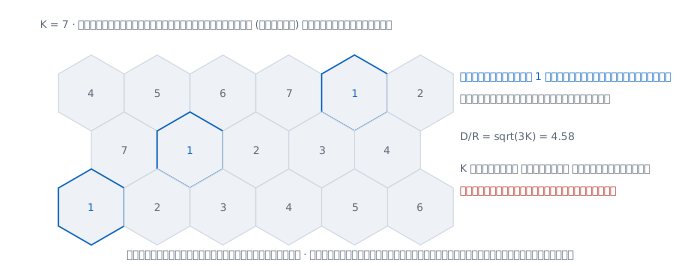
The answer is to divide the area into small cells, lower the transmit power so each covers only its own cell, and use the same frequency set again in a cell farther away.
The price is that cells sharing a frequency interfere with each other, so they must be far enough apart — and that distance dictates how many sets the frequencies must be split into.
Call the number of sets K. Then the distance between cells sharing a frequency, relative to the cell radius, is sqrt(3K).
   K   channels/cell   D/R
   1        125         1.73
   3         41         3.00
   4         31         3.46
   7         17         4.58
  12         10         6.00
A larger K puts co-channel cells farther apart and reduces interference, but gives each cell fewer channels — a direct trade of quality against capacity.
Nothing has been gained yet. There are still 125 channels; at K=7 each cell has only 17, which looks worse than before.
What changes everything is in the next section.
Cell splitting — the heart of the whole thing
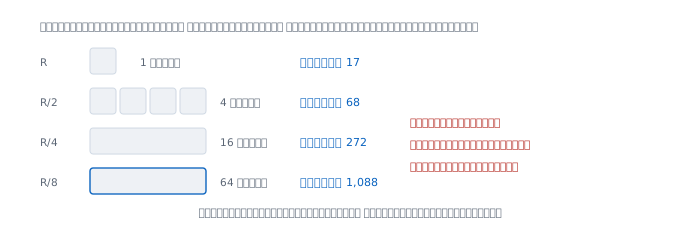
Area grows with the square of the radius, which means halving the radius quadruples the number of cells in the same area.
  radius    cells    total capacity (K=7)
  R             1                      17
  R/2           4                      68
  R/4          16                     272
  R/8          64                   1,088
Capacity quadruples every time the radius halves, without asking for a single extra hertz.
That is what cellular actually invented, and why it scales without limit in theory — unlike the earlier system with its fixed ceiling.
The price is the number of base stations, which quadruples too.
Three ways to add capacity, and only one has no ceiling
The channel ceiling article shows that a single channel has a computable ceiling. Put that together with cells and the full picture appears.
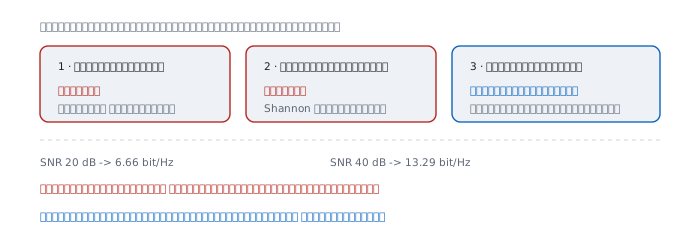
One, get more spectrum. Limited by regulation and by physics.
Two, get more bits per hertz. Limited by Shannon's ceiling.
Three, make the cells smaller. No theoretical ceiling.
The second has a ceiling you can compute directly.
  SNR      max bit/Hz
  10 dB       3.46
  20 dB       6.66
  30 dB       9.97
  40 dB      13.29
Going from 20 to 40 dB SNR is a hundredfold increase in power for exactly twice the bits per hertz. That is the wall every generation of mobile technology runs into.
The third has no such wall. Halve the radius, get four times, every time.
That is why operators spend money on towers rather than on spectrum, and why masts in big cities keep getting denser until some sit a few hundred metres apart.
What each generation bought
Once you know there are three levers, you can read the history of each generation as a choice among them.
  1G   analogue, one frequency per call, one call fills one channel
  2G   digital, several calls share a channel by time or by code
  3G   data first, more bits per hertz, more flexible resource sharing
  4G   all packet, voice becomes just another kind of data
  5G   wider channels, higher frequencies, and much smaller cells
Note that from 3G onward everything is lever two and lever three, because lever one ran out long ago.
And 5G using higher frequencies is not incidental. Higher frequencies travel less far, which sounds like a drawback, but it is lever three automatically — the cells get smaller because the signal does not reach, and capacity rises by the geometry above.
What this does not prove — the generation table above is a summary written from general understanding, not lifted from 3GPP specifications, because those documents would not download while this was written. Everything computed in this article can be re-derived from the formulas given.
Handover between cells
As cells shrink, the same device crosses between them more often, and every crossing requires a handover.
This is the hidden cost of lever three — smaller cells mean more frequent handovers — and every handover is an opportunity for the call to drop. It is why networks in dense cities work far harder than their users see.
It also explains a common symptom: full bars but the call will not connect, or a drop while travelling with the bars full the whole time. The problem is not signal strength; it is the handover, or the cell being full.
When it lies
"Full bars means it works well." Bars show the signal strength from the tower, not whether that cell has room left — the same situation as Wi-Fi, where full bars sit alongside full air.
"5G is faster because the technology is new." Mostly it is faster because the channels are wider and the cells are smaller — levers one and three, not because anyone got past Shannon.
"Turn up the tower's power for better coverage." Coverage widens, but so does the cell, which lowers capacity by the geometry above, and it interferes with the cells sharing that frequency.
"Lower frequencies are always better because they reach further." They do reach further, but a bigger cell means more people sharing it. In a dense city, higher frequencies that reach less far give more total capacity.
"Cellular is just Wi-Fi at longer range." The medium-sharing principles are very similar. The difference is that cellular frequencies are planned centrally while anyone can set a Wi-Fi channel to anything, which is why the 2.4 GHz band is the mess the Wi-Fi article measured.
Real cases from real work
Case 1 — computing how many cells an area needs
Situation You need a rough estimate of how many simultaneous users an area can support.
How to read it Use three numbers — available spectrum, channel width, and K — then multiply by the number of cells.
  total channels     = spectrum / channel width
  channels per cell  = total channels / K
  system capacity    = channels per cell x number of cells
If the required capacity exceeds the result, the reliable fix is more cells, not more power.
What this does not prove The calculation is idealised: equal hexagons and evenly spread users. In reality buildings and terrain distort the cell shapes, and users cluster.
Case 2 — full bars but nothing works
Situation At a crowded event, the bars are full but nothing loads.
How to read it Bars show signal strength from the tower, which is a separate question from whether that cell has capacity left. When people cluster into a small area, users per cell rises while channels per cell does not. Moving closer to the tower will not fix it, because the problem is capacity, not strength.
What this does not prove The same symptom arises when the circuit connecting the tower back to the network is saturated, which is a different place entirely. From the user's side the two are indistinguishable.
Case 3 — choosing a frequency band for an area
Situation You must choose between a low and a high band.
How to read it Ask whether the problem is coverage or capacity.
Low bands reach further and penetrate buildings better, giving large cells and low capacity per unit area.
High bands reach less far, giving small cells and high capacity per unit area, but needing many more sites.
Rural areas with few people and long distances need low bands. Dense city centres need high bands and small cells. Using a low band to fix a capacity problem in a city is solving the wrong thing.
What this does not prove The real choice also depends on which licences the operator holds and what equipment users carry — constraints that have nothing to do with physics.
What this shares with every earlier article
A mobile network looks like a different world from cabling in a building, but the constraints are the same set — the medium is shared with others, each channel has the ceiling Shannon defined, and capacity is added by splitting users into smaller groups.
That is exactly what switches did to Ethernet when they replaced hubs: shrink the collision domain until it holds one port. Cellular does the same, except the domain is a piece of geography rather than a length of cable.
References
Computed here
- The reuse table is computed from 25 MHz of spectrum in 200 kHz channels and the relation
D/R = sqrt(3K) - The cell-splitting table follows from area scaling with the square of the radius
- The bits-per-hertz table comes from Shannon's formula, which the channel ceiling article cites from the 1948 original
What could not be verified at the source
- The summary of what each generation bought is written from general understanding, not taken from 3GPP specifications, because those documents would not download while this was written. The specifications themselves are at 3GPP.